SEO vs AI visibility: what's the difference?
SEO gets you onto Google's results page; AI visibility gets you named in ChatGPT, Gemini and Google AI answers. How they differ, where they overlap, and how to do both without doubling the work.
Paladzo team · · 2 min read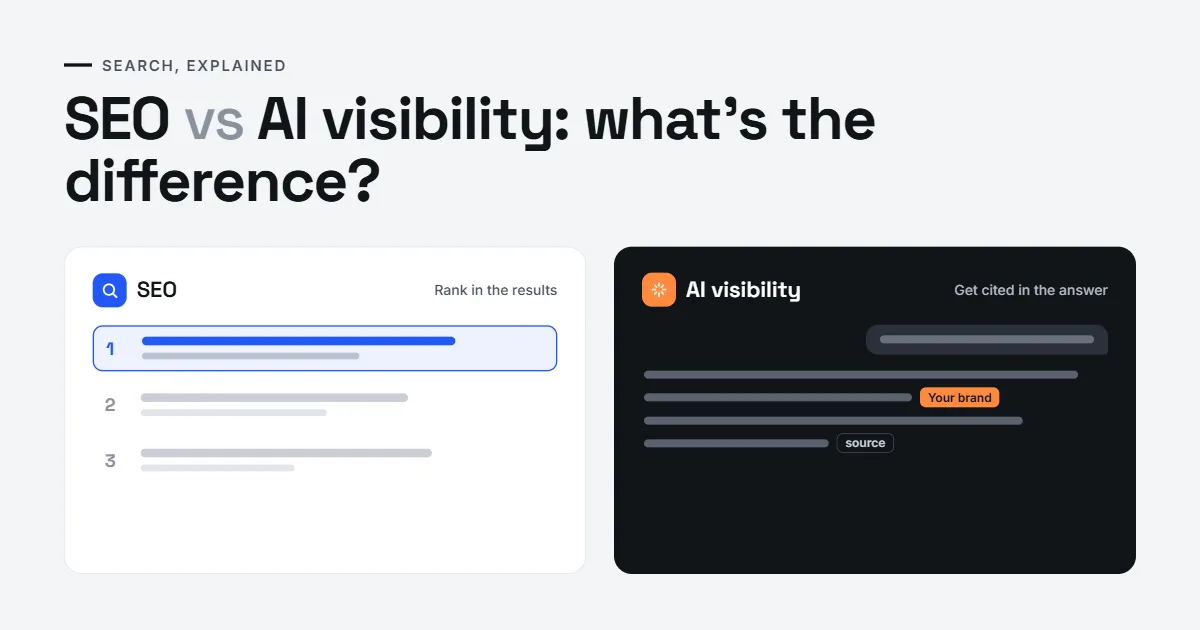
Customers now look for businesses in two kinds of places. They still type into Google and scroll a list of results. And more and more, they ask an AI assistant such as ChatGPT, Gemini or Google's AI Overviews, which writes an answer that names a handful of businesses.
SEO (search engine optimisation) is how you show up in the first. AI visibility, also called GEO (generative engine optimisation), is how you show up in the second.
The short version
- SEO: you want to rank high on a list of links, so people click through to your site.
- AI visibility: you want to be named in a written answer, described correctly, ideally with a link.
Side by side
What the customer sees
- SEO: a results page with ads, maps and ten or so links.
- AI visibility: a few paragraphs that recommend two or three businesses.
How many businesses get a chance
- SEO: the first page shows about ten, and people do scroll.
- AI visibility: often only two to five names. If you are not one of them, you are not in the conversation.
What decides the result
- SEO: relevance of your pages, links from other sites, speed, and how well Google can read your site.
- AI visibility: much of the same, plus how clearly your site states what you do, what reviews and other websites say about you, and whether your details agree everywhere.
How you measure it
- SEO: rankings and clicks, in tools like Google Search Console.
- AI visibility: whether each assistant names you, in what position, next to whom, citing which sources. No free tool from the AI companies shows this.
How stable it is
- SEO: rankings move, but usually gradually.
- AI visibility: answers can change from week to week, and differ between assistants for the same question.
Where they overlap
The good news is that most of the work counts twice:
- A fast site that works well on phones.
- Clear pages that say what you sell, where and for whom.
- Answers to real customer questions.
- Business details code that tells engines your name, address and hours.
- Links and mentions from relevant, trusted sites.
- Good reviews and consistent details on Google Maps and directories.
Do these well and you improve both your Google rankings and your chances of being named by AI.
Where they differ in practice
Two things are specific to AI visibility:
- Letting AI read your site. Some websites block AI crawlers without knowing it. Check with the free AI crawler checker, and consider an AI summary file (make one with the AI summary file maker).
- Being mentioned where AI looks. Assistants lean on round-ups, review sites, directories and forums. Getting listed there matters more than it used to.
Which should you focus on?
Both, and you don't need two separate projects. Fix the shared foundations first (the free site audit lists them in order), then track both:
- SEO Toolkit for Google rankings, keywords and competitor gaps.
- AI Visibility for what ChatGPT, Gemini, Claude, Copilot and Google AI Overviews say about you, and who they name instead.
Paladzo puts both in one place, because your customers use both. For a gentler introduction to the AI side, read What is GEO?.